
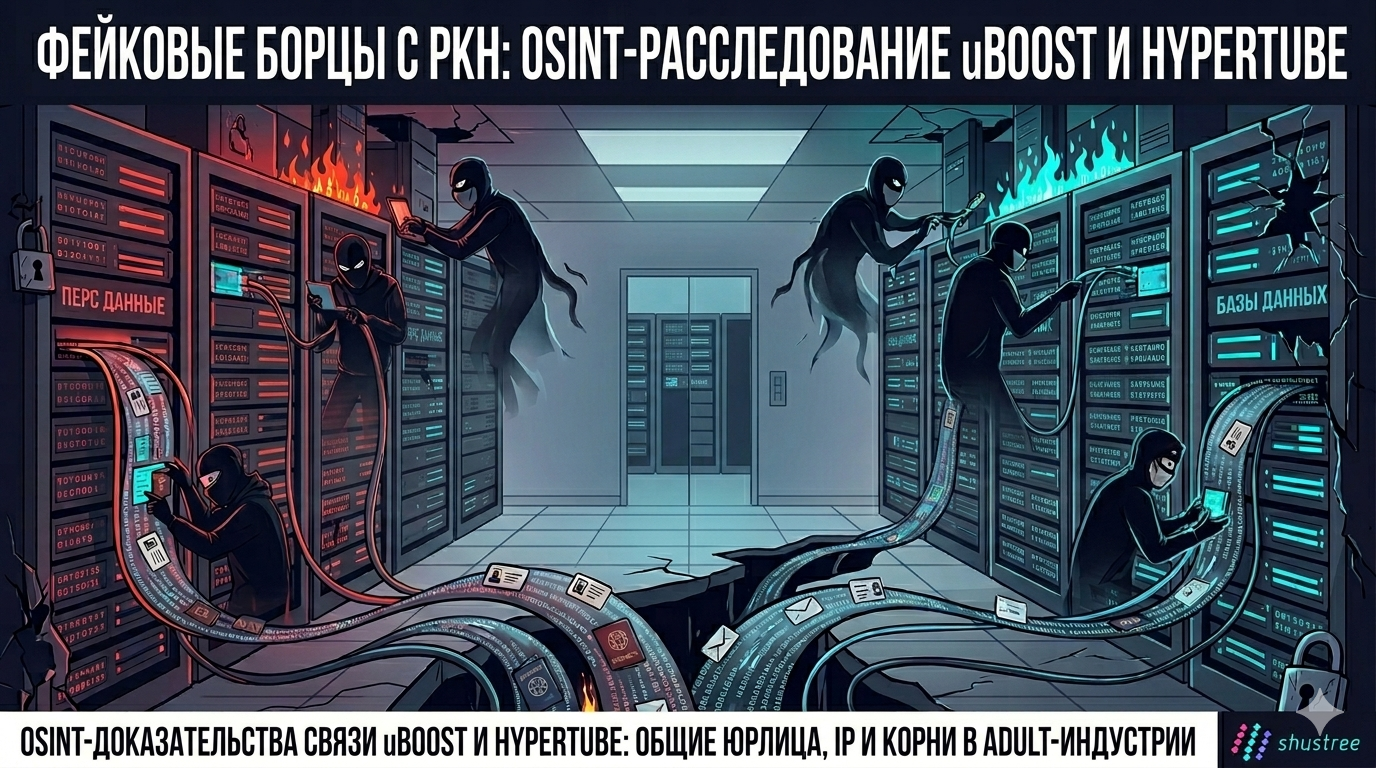
Whenever a free browser extension designed to bypass YouTube throttling experiences infrastructure downtime, a distinct PR strategy unfolds across public Telegram channels. Operators deploy an adversarial narrative: "Roskomnadzor (RKN) has launched another sophisticated attack. Our engineering team is working continuously under cyber-warfare conditions to deploy new nodes."
This communication strategy successfully converts operational failure into user sympathy and brand loyalty. However, objective technical analysis reveals this narrative to be fundamentally artificial. Users are systematically led to support entities that operate entirely outside the scope of digital rights, utilizing client browsers as leverage for non-transparent traffic monetization and grey-market ad networks.
This report deconstructs the architecture of these systems, identifies the controlling entities behind them, and details why deploying extensions such as uBoost, HyperTube, "VPN Naoborot", or "Vrubel" presents significant security risks and ethical conflicts.
Section 1. Deconstructing the "State Adversary" Narrative: Regulatory Reality
When the operators of uBoost attribute service degradation to direct targeted attacks by Roskomnadzor, they leverage a general lack of familiarity with public regulatory frameworks. An examination of the official legal mandate—The Statute on the Federal Service for Supervision of Communications, Information Technology and Mass Media (RF Government Resolution No. 228)—outlines strict operational boundaries.
The regulator possesses no technical or legal authority to conduct offensive cyber operations, inject arbitrary faults, or physically compromise remote infrastructure. Pursuant to Clauses 5.1.7(1) and 5.1.9 of the Statute, the agency is exclusively empowered to:
- Append network identifiers to the centralized registry of prohibited resources (triggering deep packet inspection filtering via TSPU hardware installed at domestic ISP borders).
- Execute centralized management over public electronic communication networks solely during officially declared state threats.
The regulator operates purely as an ingress/egress filtering authority at domestic provider boundaries. It cannot unilaterally disable infrastructure hosted in foreign jurisdictions or independent domestic data centers without specific legal proceedings.
The Core Technical Cause of Downtime
The root cause of service interruption within systems like uBoost is typically unrelated to state regulatory interference. Instead, it stems from automated content delivery mitigation enforced by Google. Google actively maintains stringent Anti-Bot and Anti-Scraping sub-systems to prevent unauthorized automated parsing, proxying, and downloading of high-bandwidth video content.
When hundreds of thousands of concurrent clients route high-volume video streams through a highly concentrated pool of proxy IP addresses, Google's threat intelligence models flag the anomaly. This results in an immediate automated block of those specific outbound proxy nodes.
Disclosing this limitation would force operators to acknowledge structural architectural flaws and unsustainable scaling models. Attributing standard platform-side automated blocks to a geopolitical digital conflict is a highly effective marketing technique designed to obscure technical limitations and drive organic user acquisition.
Section 2. Search Engine Warnings: Automated Compliance Labeling
Operators frequently point to specialized notifications appended to their entries within the Yandex search engine index—such as "Foreign resource violating local legislation"—as proof of targeted political non-compliance profiling.
In practice, this warning label is an automated systemic response to non-compliance with Federal Law "On the Activities of Foreign Persons on the Internet", specifically concerning localized personal data storage mandates. Currently, this compliance status is applied uniformly to over 500,000 global domains, ranging from localized e-commerce platforms to major informational repositories like Wikipedia and StackOverflow. The status triggers automatically when an external entity processes regional user telemetry but declines to maintain localized database infrastructure. It does not indicate targeted or unique tracking directed at uBoost or its variants.
Section 3. Infrastructure Correlation: Adult Industry Telemetry Routing
Maintaining high-bandwidth proxy infrastructure capable of processing streaming data for millions of active installations demands massive capital expenditure. The monetization model explains why this infrastructure is provided at no apparent cost to the consumer.
OSINT analysis demonstrates that uBoost, HyperTube, "VPN Naoborot", and "Vrubel" are structurally linked components of a single operational entity. The primary revenue architecture of this entity exists entirely outside mainstream software utility frameworks, focusing instead on adult entertainment traffic monetization.
The entity operates a dual-tiered distribution infrastructure:
- Grey-Market Tier (uBoost): Distributed aggressively via high-volume Pop-under networks embedded directly within adult web portals. When a client encounters playback buffering on these external networks, a programmatic prompt suggests installing the utility to "optimize performance." This funnels high volumes of unvetted traffic into the network. The underlying servers and subnets directly host adult affiliate programs, ad-delivery networks, and unstructured streaming endpoints that lack basic data moderation protocols.
- Clean-Market Tier (HyperTube): A functional clone of uBoost rebranded under a conventional software naming convention. This application is positioned as a legitimate network optimization utility, allowing it to pass standard algorithmic compliance checks on mainstream advertising platforms, including Yandex Direct.
By executing these software packages, clients inadvertently integrate their local browser environments directly into an ecosystem designed around grey-market traffic routing, passing active user metrics through identical server pools.
Section 4. Monopolistic Constraints, Source Obfuscation, and Script Injection
The secondary risks associated with these extensions involve significant structural anomalies hidden within their application logic. uBoost and its direct derivatives act as aggressive, monopolistic agents within the local execution environment, actively seeking to suppress or terminate the network configurations of competing proxy tools and VPN utilities.
To achieve this, the application manifests demand highly elevated, insecure permission structures, requesting complete authority over web requests and external browser extensions. This configuration is falsely presented to non-technical users as an absolute engineering prerequisite for data acceleration. In reality, it serves as a defensive competitive mitigation strategy to establish exclusivity over the host's network routing.
More severe security concerns include:
- Unmonitored JavaScript Injections: These extensions retain the capability to dynamically inject arbitrary JavaScript payloads into active Document Object Models (DOMs) across visited domains. Because these payloads are fetched dynamically from remote endpoints, external security teams cannot audit the operations performed within sensitive contexts, such as active online banking sessions or internal corporate dashboards. Modern proxy routing can be executed seamlessly without local DOM manipulation; its inclusion suggests a deliberate choice to retain deep client-side insight.
- Advanced Code Obfuscation: The source code of uBoost and its direct derivatives is heavily obfuscated using advanced transformations specifically engineered to block reverse engineering and security audits. De-obfuscation reviews reveal a large volume of auxiliary sub-routines completely unrelated to standard proxy operations executed via the native Chrome Extension chrome.proxy API.
Installing these packages grants unverified, non-auditable software complete operational control over the local browser context.
The Transparent Alternative: Shustree Architecture
At Shustree, we operate under a strict zero-trust engineering paradigm. We reject narrative-driven PR strategies to mask operational faults and maintain a transparent, minimal-privilege architecture built on verifiable operational criteria:
- 100% Verified Clean Traffic: We maintain strict exclusions against grey-market advertising networks and unverified adult infrastructure providers. Entities propagating malicious payloads, high-risk content, or bulk messaging are permanently restricted at our routing layer.
- Compliant Data Centers: Our core routing infrastructure (including key European connectivity points such as Frankfurt) is hosted exclusively within certified Tier-3 data centers operating under transparent corporate compliance frameworks.
- Verifiable Open Source Code: We reject all forms of code obfuscation. Every development phase is comprehensively documented, and every compiled release is pushed transparently to our official public GitHub Repository, allowing independent security audits at any time.
- Minimalist Permission Models: We adhere strictly to the principle of least privilege. The extension runs on a clean, isolated manifest file, never interferes with co-existing proxy software, and avoids all unnecessary privileges. We do not request cookie store access, as our architecture intentionally prevents the correlation of local user identities with external telemetry platforms.
- Operational Transparency: We communicate solely via verifiable technical metrics. Shustree is an engineered, stable utility designed to preserve data integrity through transparent technology rather than ideological messaging.
Prioritize your digital security. Retain complete control over your browser environment and reject non-auditable telemetry collection.
Appendix 1. Technical Verification of Node Location
While public GeoIP registries often list "Netherlands" or "Germany" as the registration origin for these proxy networks, physical packet routing analysis locates the hardware within Moscow (primarily routed through the MMTS-9 internet exchange). Operators utilize BGP Anycast routing to broadcast network identifiers globally, masking the true physical endpoints. This can be verified within two minutes via standard networking tools:
- Activate the uBoost extension. Open the browser Developer Tools (F12), navigate to the Network Tab, refresh an active video stream, and identify the outbound proxy IP listed within the Remote Address field.
- Copy the designated IP address and access an automated global network testing utility such as Ping.pe.
- Input the destination IP into the diagnostic field to trigger simultaneous ICMP echoes from multiple geographic vantage points.
- Analyze the Round-Trip Time (RTT) values: Querying the IP from nodes in Amsterdam or Frankfurt demonstrates anomalous latencies ranging between 35–45 ms (indicating physical backhaul routing into Eastern Europe). Conversely, queries executed from domestic Moscow nodes return tight latencies between 0.5–2 ms.
Physical propagation limits cannot be falsified; the hardware is physically situated within the region. Furthermore, unhindered data flow for localized messaging protocols across these specific subnets indicates they operate within whitelisted domestic routing zones exempted from standard DPI filtering blocks.
Appendix 2. Mapping Shared Subnet Infrastructure
To map the infrastructural intersection between free acceleration extensions and grey-market adult platforms:
- Extract the active proxy destination IP address using the methodology detailed in Appendix 1.
- Query the identifier using the Hurricane Electric BGP Toolkit (bgp.he.net) to extract the Autonomous System Number (ASN) and the upstream infrastructure provider.
- Isolate the associated CIDR block block allocation (typically a /24 subnet architecture).
- Query the allocated subnet via specialized internet security search engines such as Shodan.io or Censys. The results reveal that adjacent IP allocations within the exact same rack regularly register active SSL/TLS certificates mapped to grey-market adult scripts, webcam management panels, and traffic redirection endpoints, indicating unified administration under a single infrastructure contract.
Appendix 3. Corporate Tracking: HyperSoft Global Entity Correlation
While network anomalies and Anycast routing can be dismissed as coincidental configuration choices, public corporate registries and global application marketplaces provide immutable evidence. The operational link between uBoost and HyperTube is verified directly through public legal entities. Both operations converge structurally on a single corporate body: HyperSoft LLC (operating internationally as HyperSoft Global LLP).
Documented Evidence Chain:
- Google Play Marketplace Entry: Inspecting the official developer metadata for "HyperTube — YouTube Acceleration" within the Google Play Store identifies the controlling entity as HyperSoft Global (HYPERSOFT GLOBAL LLP), utilizing `team@hyper-tube.net` as the primary support vector.
- Corporate Entity Re-Registration: Following an internal corporate governance conflict, uBoost migrated operations to the domain `youboost.tv`. The legally mandated terms of service and public oferta on this domain explicitly identify the domestic corporate entity as HyperSoft LLC (INN: 9714065578 / OGRN: 1247700797750), maintaining `team@hypersoft-team.com` as its corporate communications channel. Entity validation is accessible via the Federal Tax Service of Russia (EGRUL).
- Cross-Application Mapping ("VPN Naoborot"): HyperSoft LLC (INN 9714065578) is registered as the statutory owner of the "VPN Naoborot" platform. Concurrently, the identical software utility is published within the international Apple App Store with the publisher field assigned to HYPERSOFT GLOBAL LLP, closing the entity correlation loop.
Infrastructure & Entity Correlation Matrix (OSINT Map)
| Parameter | uBoost Utility (youboost.tv) | HyperTube Utility (hyper-tube.net) |
|---|---|---|
| Official Domain | youboost.tv | hyper-tube.net |
| Registered Entity | HyperSoft LLC (Stated in Legal Oferta) | HyperSoft Global (Stated in Google Play Metadata) |
| Tax Identification (INN) | 9714065578 | Correlated via mutual "VPN Naoborot" deployment |
| Corporate Communications | team@hypersoft-team.com | team@hyper-tube.net (Identical naming convention) |
Conclusion: Public regulatory data and application metadata confirm that behind the facade of independent anti-censorship software developers lies a single, centralized corporate cluster. The entities operating under HyperSoft, uBoost, and HyperTube exercise unified administrative control over the entire network infrastructure, systematically converting user routing nodes into clean ad-monetization vectors.